Autograph

Write music by hand. Watch it engrave itself.

A notation app for iPad and Apple Pencil.

Join the free beta Through TestFlight, on iPad. Free while the beta runs. Places are limited.

What it does

You write on the staff the way you would on paper. Autograph reads the stroke and sets it properly: the notehead on the right line, the stem the right way up, the beams and accidentals where an engraver would put them. The handwriting disappears; the music stays.

It is built for the moment before a piece is finished: working out a phrase, writing an exercise for a student, getting an idea down before it goes. Not for typesetting a symphony.

Also

  • Hear it back. Every bar plays through a sampled instrument, so a wrong note is something you notice rather than something you find later.
  • Type or play it instead. A keyboard and a MIDI keyboard both write notes, if that suits the moment better than handwriting.
  • Two hands, several voices, lyrics. Grand staff, multiple voices to a staff, words under the notes.
  • It leaves with you. Export PDF for printing, MusicXML for Sibelius, Finale, Dorico or MuseScore, and MEI for scholarly work. Open other people's MusicXML and MEI files too.
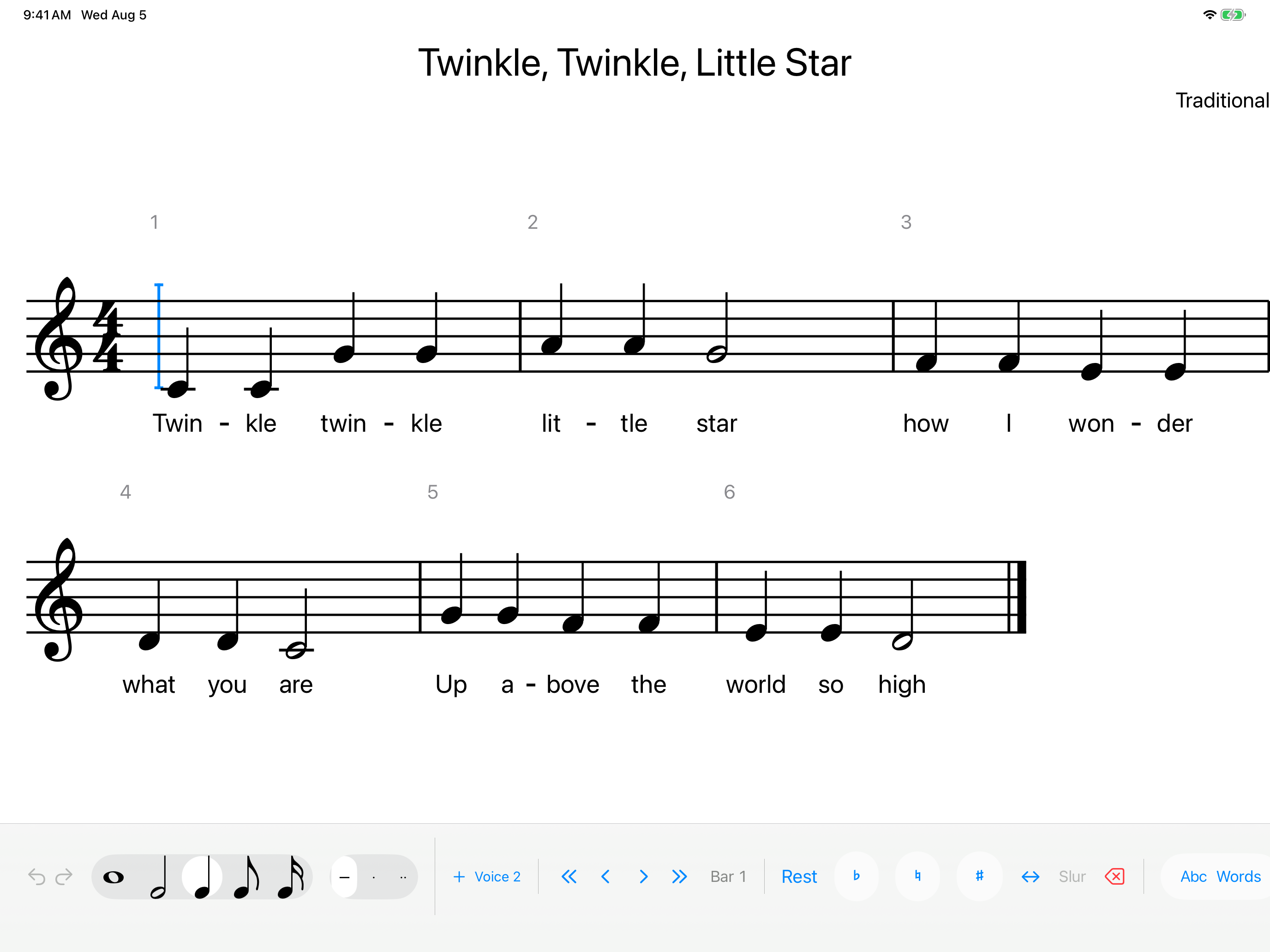
Words under the notes, and they stay with the notes when the music re-spaces.

What it looks like

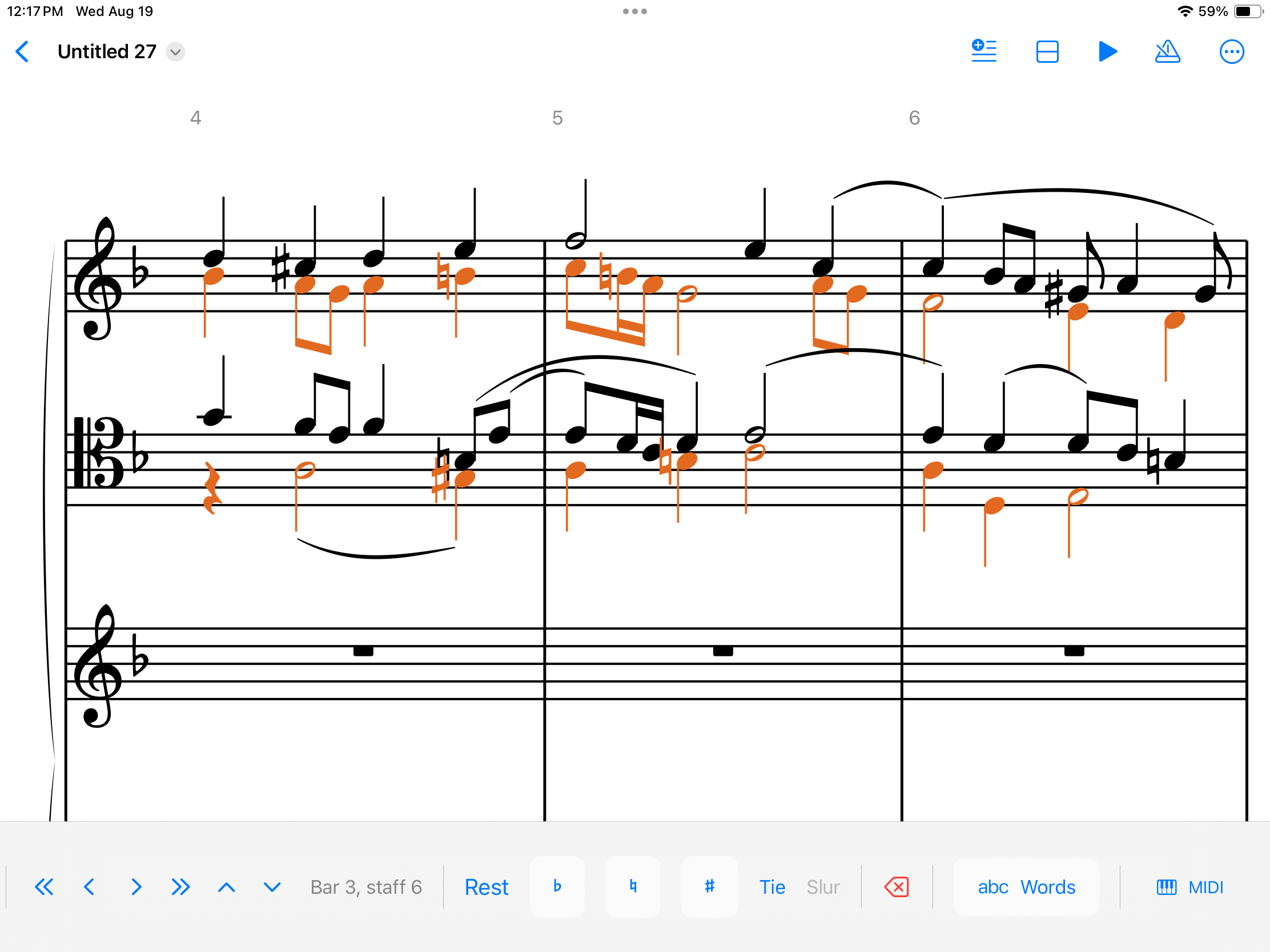
Two staves of piano music, engraved, with a second voice on each staff
                  drawn in orange — slurs, accidentals and beamed runs across three bars.
Engraved with the Bravura music font, the same one used by professional notation software. Two voices on a staff are coloured while you write, so you can see which line you are on.
Twinkle Twinkle Little Star engraved on a single staff with lyrics.
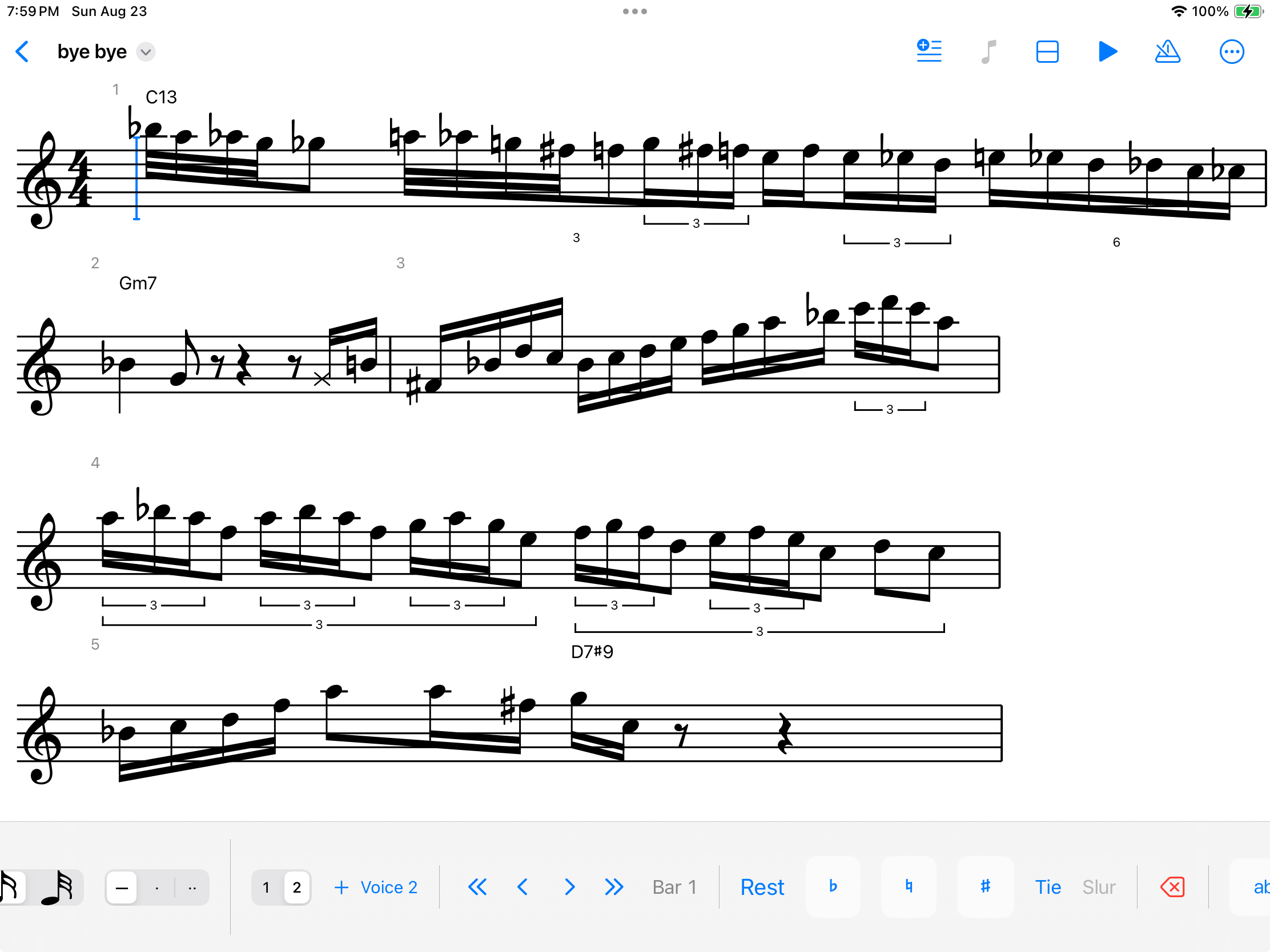
A written-out jazz solo on one staff, five bars of it: fast runs of
                  thirty-second notes carrying flats, sharps and naturals, tuplet
                  brackets nested inside one another — three triplets under one
                  longer triplet — a group of six, a cross notehead, and the chord
                  symbols C13, Gm7 and D7 sharp 9 above the staff.
Tuplets nest: a triplet whose notes are themselves triplets, and a group of six. Chord symbols sit above the staff and travel with the file.
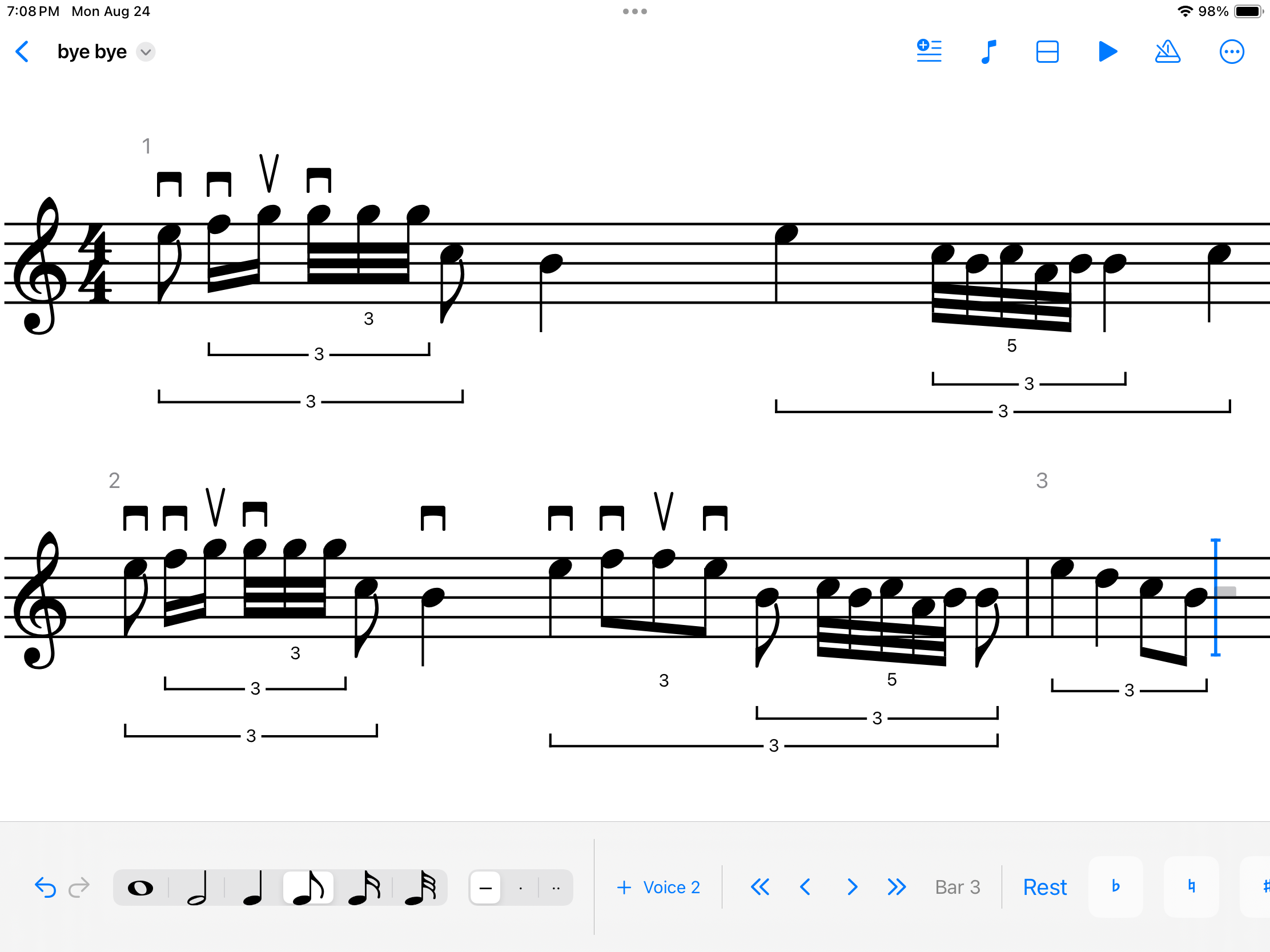
The iPad editor mid-write: two systems of violin music with down-bow
                  and up-bow marks, triplets nested inside triplets and a quintuplet
                  of thirty-seconds inside one of them, the blue insertion caret
                  standing in a half-written bar 3, and the duration, voice,
                  navigation and accidental controls along the bottom of the
                  screen.
Being written, not just displayed: the caret stands in a half-written bar, and the tuplet it is standing in holds room for the next note. Bowings over the beat, a quintuplet inside a triplet inside a triplet — and every bar still adds up.
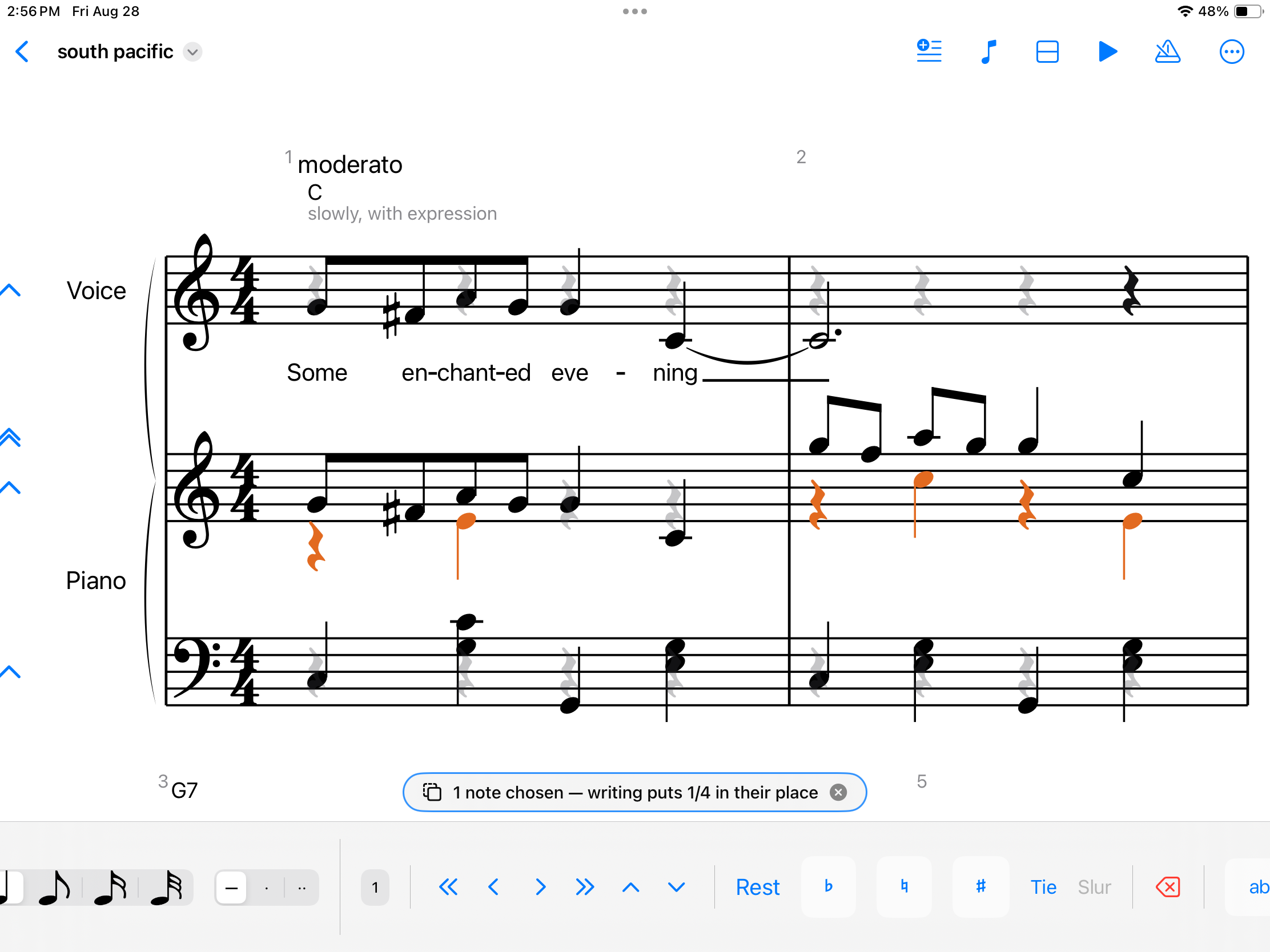
A song opening on three staves: a vocal line above a piano part
                  braced together, the words "Some en-chant-ed eve-ning"
                  under the voice with hyphens between the syllables and a line
                  carrying the held last note into the next bar, the chord symbols
                  C and G7 above, the tempo moderato and the instruction
                  "slowly, with expression" over the first bar, and a
                  second voice in the piano drawn in orange.
Words, with the hyphens and the held-note lines an engraver would draw. A song is a voice and a piano braced together, each part named at the left, with chord symbols above and the tempo where it belongs.

What you need

An iPad running iPadOS 17 or later
The iPad comes first, because writing by hand is what Autograph is for. A Mac version is in progress and will read and write the same files. There is no iPhone version.
An Apple Pencil, for the handwriting
Any generation, including the 1st. Everything else, from placing notes to editing, playback and export, works with a finger, so the app is usable without one.

The beta

Autograph is in open beta and free to use while the beta runs. It will stay that way for at least the next several months.

When it is finished it will be a paid app, bought once rather than subscribed to. Beta testers will be looked after when that happens.

Places on the beta are limited. If the link above is full, or if you would like to hear when the finished version or the Mac version arrives, send me an email.

Who made it

One person, in Toronto. I am a singing student as well as a developer, and Autograph started because writing music down on an iPad was worse than writing it on paper, and it did not seem like it had to be.

If you teach, I would genuinely like to hear what breaks and what is missing. That is what the beta is for. autographapp@icloud.com.